
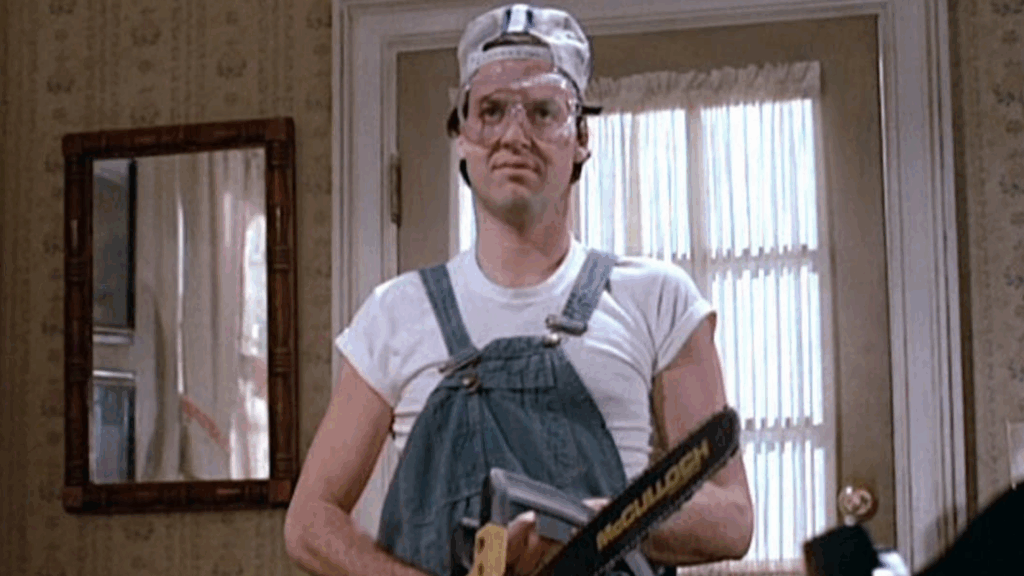
If you watched Mr. Mom as a kid in the ’80s or ’90s, chances are you remember the jokes: the demon-possessed vacuum cleaner, the diaper disasters, the chainsaw bravado, and the chaos in the grocery aisle. It played like a sitcom on fast-forward — all gags, all chaos, all the time.
But watching it again today as part of our Regular Guy Movie Show rewatch, we were struck not by how funny it was (some moments still land), but by how much it squandered its own premise.
At the heart of Mr. Mom is a decent idea: what happens when traditional roles get flipped, and a man is suddenly thrust into full-time domestic life while his wife reenters the workforce? That’s ripe territory for both comedy and commentary. Unfortunately, the movie chooses to chase pratfalls instead of progress.
Opportunity Missed
What could have been a sincere and even groundbreaking exploration of partnership becomes a slapstick-heavy sketch reel. The film tiptoes toward something honest — how couples navigate power shifts, how self-worth gets tangled up in career identity — but then undercuts it all with cartoonish mishaps and poorly written moments.
Probably the most frustrating thing about this movie is that its two leads—Michael Keaton and Teri Garr—perform exceptionally. They bring true personality and energy to their roles and shine. Unfortunately, their roles are poorly conceived and inconsistently written, and their characters are repeatedly placed into situations that look authentic from a distance but, upon closer inspection, defy any and all logic imaginable.
So much of this movie’s crux hinges on two assumptions whose expiration date has long passed and, quite frankly, were likely out of date even at the time this film was made: that dads know absolutely nothing about doing things around a house and that husbands and wives don’t communicate…seemingly about anything.
Jack is thrust into being the primary caretaker of the household, but has zero idea what any of that entails. He doesn’t know where the vacuum is, he can’t find the diapers, and it is an absolute mystery to him how to operate the washing machine. The shift in dynamics caused by their role reversal would have had plenty of potential for drama, comedy, and everything in between. Making him an incompetent boob was unnecessary, way over the top, and not an idea that aligns with any reality any of us at The Regular Guy Movie Show can relate to.
Beyond that, much of the movie’s drama stems from Jack and Caroline not talking. He’s mad because she doesn’t know about the things happening in the house while working. Yes, she has been working like you did before this, but she is still home nights and weekends. Even with those late nights working with creepy ass Ron, she is still around as much as she can be. You have time to catch up. Regardless, she gets promotions that he never hears about. Kids start football and lose teeth; she doesn’t know about it. Why not?
This film showed the evolution of a marriage based on mutual respect and teamwork, and how these two individuals work together to navigate the changing dynamics. Instead, we get two ships passing in the night, resentment, lots of miscommunication, and a brief confrontation followed by a happy moment watching a tuna commercial, which is presented as a resolution, though I am not quite sure how.
Grocery Store Insanity
The infamous grocery store scene is one of the best examples of how Mr. Mom abandons substance in favor of cheap laughs. What starts as a potentially relatable moment — a parent overwhelmed in a new environment — quickly escalates into full-blown farce. Jack charges through the aisles like he’s in a demolition derby, toppling stacks of melons and cans left and right, and getting utterly lost in the sea of options at the deli counter, as if this man could not have known there was more than one kind of cheese.
But the truth is, grocery shopping is not some Herculean task. It does not require war paint and a game plan on par with a military operation. By turning such a simple moment into a chaotic, over-the-top spectacle, the film reinforces the idea that domestic duties are laughably foreign and intimidating to men, which, frankly, does a disservice to both men and women.
Rather than using this scene to show Jack as a capable and adaptable human being, it presents him as a fragile individual on the verge of emotional collapse, who loses not one, but two children in the process! We could have seen him learning, adapting, or even making an honest mistake in a real-world scenario, but instead, this film opts for absurdity and absurdity alone. It’s emblematic of the film’s larger issue: choosing slapstick over sincerity every time there’s a chance to do something meaningful.
While he eventually gets better at this, and the film manages to deliver a few endearing nuggets along the way – the wubby scene in particular- his character arc is less than complex. First he is clueless and sucks at everything. He loses it and descends into madness – which we can tell becasue he grew a beard and wears a flannel shirt as if those are shorthand for depression – and then thanks to a typical 1980s training montage, he is back on top kicking butt, taking names, and parenting with ease…although still finding the time to amass a mountain of resentment towards his office working partner.
It would have been much better to see him as a more nuanced individual from the start instead of broad shifts in persona.
Housework in general is not a concept entirely foreign to men. Not now, or even in the 1980s. Even when this film was made, men were responsible, on average, for about 30% of the work around the house. If Jack had been doing 0% of the work…that’s on him…but to be more accurate…it’s on the screenwriters who gave this man too little credit and too little backstory.
Selling Women Short
While the focus is understandably on Keaton’s character, the film does Caroline (Teri Garr) no favors. She lands a significant job at an ad agency and navigates the boys’ club with intelligence and resilience — and the movie responds by undermining her every step of the way. The boss is a sleaze, her colleagues are clichés, and instead of celebrating her rise, the story makes it very clear that she is only moving ahead because her boss finds her sexy.
Despite her lack of on-paper qualifications, only a couple of years of experience, followed by an eight-year gap in her resume, Caroline manages to land a job, which she excels at. She has talent. She has instinct. She is really good at what she does. We could have seen her rise and prosper on those merits alone, but nope…not in this movie. Instead, it is abundantly clear from her first moments at the advertising agency that her path to success has been paved with Ron’s desire to get her into bed.
Lunch interviews, having her call him “Ron,” flying her off in his private plane on day two of her job. He’s flexing every chance he gets, and being not the least subtle about it. He overtly wants her and looks forward to many late nights together.
While women certainly face these kinds of predatory executives in the real world, which is a genuine shame, this movie essentially acts as if this is just part of the normal day-to-day, and it is just to be accepted. This ultimately takes what could have been a real, ahead-of-its-time success story for Caroline as a female character, and instead twists it to be a reinforcement of the more traditional idea that women are just something pretty to look at.
The other thing this movie does, which is absolutely infuriating, is portray Caroline as incapable of stepping out of “mom mode.” We see her picking up trash during a team meeting. We see her cutting up Ron’s steak. Yes, she is a mom—we get it—but the idea that a woman can’t switch out of a toddler care mindset in a professional setting is absurd and generally insulting to women.
Creeps in Suits
Let’s not overlook the boss problem. From Joan’s predatory supervisor to Jack’s emotionally manipulative ex-colleague, the film is filled with men whose behavior should’ve raised red flags even back in 1983. But rather than confront that toxicity, the movie normalizes it. It’s presented as part of the comedy — something to wink at, not reckon with.
When Ron sneaks into Caroline’s hotel room and she finds him after coming out from the shower, her first question to him is, “Who was on the phone?” Questions about “why are you in my room” only come much further into a conversation that should never have happened.
Jack’s boss, Jinx, admits to being a white-collar criminal, a book cooker, and a general piece of crap. Still, when the film wraps up, all that is forgiven as long as Jack comes back to work and the terms negotiated by the exterminator are satisfactory to both parties.
Ultimately, comeuppance for poor corporate behavior for either of these two individuals only comes in the form of comically timed punches. Being a creep is okay if the paychecks you sign are big enough.
So… Does It Hold Up?
Not really.
Yes, Keaton is charming and Garr is radiant. Yes, a few lines and visual gags still get a laugh. And sure, there are a few moments where they somehow manage, despite their slapstick intentions, to still deliver authenticity. But overall, Mr. Mom is a film more interested in broad laughs than brave storytelling. It trades sincerity for slapstick and, in doing so, sidesteps the chance to say something real about evolving family roles.
If you’re nostalgic for it, we get it. But nostalgia isn’t the same as quality; in this case, it’s covering up a lot of missed potential.